Commercial Restroom Cleaning: Schedule, Method and Odour
A restroom can look acceptable from the doorway and still lose you a client the moment someone reaches for a sticky door handle, finds an empty soap dispenser, or notices an odour. Commercial restroom cleaning is the part of a facility where standards are judged fastest and most harshly, and where cutting frequency shows soonest.
This guide gives facility managers, office administrators and retail operators a task and frequency schedule, the difference between cleaning, sanitising and disinfecting, the consumables protocol that stops dispensers running dry, and the odour problems that recur no matter how often the floor gets mopped.
Why Restrooms Set the Standard for the Whole Building
Restrooms take the most labour per square foot of any area in a commercial building, and they are the space visitors use to judge everything they cannot see. A spotless lobby and a neglected restroom do not average out. The restroom wins.
They are also where the gap between “cleaned” and “clean” is widest. A surface can be wiped and still carry residue. A floor can be mopped and still smell, because the smell is not coming from the floor. Getting restrooms right is mostly about method and frequency rather than effort.
The Restroom Task and Frequency Schedule
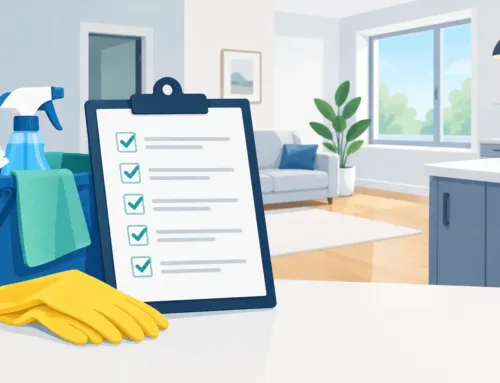
Use this as the restroom section of a commercial cleaning scope of work. Frequency assumes a standard office; high-traffic retail, clinics and venues move most rows up a level.
| Task | Frequency | Notes |
|---|---|---|
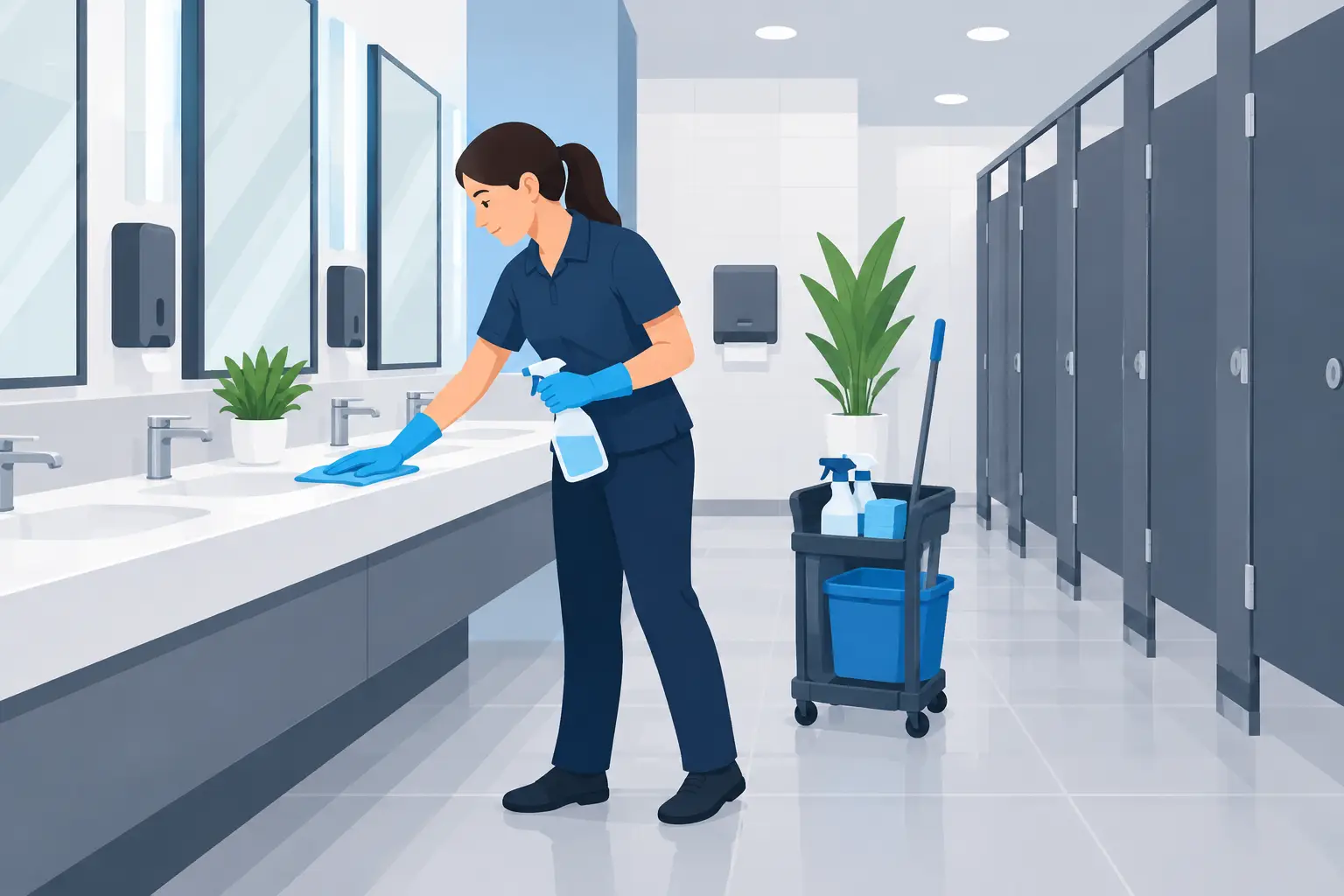
| Disinfect toilets and urinals, inside and out | Every service | Include the base and the wall behind |
| Disinfect high-touch points | Every service | Handles, locks, flush levers, dispensers, switches |
| Sinks, taps and counters | Every service | Dry taps to prevent water spotting |
| Mirrors and glass | Every service | Streak-free is the observable standard |
| Empty waste and sanitary bins | Every service | Replace liners, do not overfill |
| Restock consumables | Every service | Per the supply protocol below |
| Mop floors with correct dilution | Every service | Change water between restrooms |
| Partition walls and doors, both sides | Weekly | Hinges and edges collect fast |
| Door and kick plates | Weekly | Highest-contact surface in the room |
| Vent grilles and extractor covers | Weekly | Dust here recirculates |
| Descale taps, flush valves, urinals | Monthly | Needs dwell time, not scrubbing |
| Grout and floor edge detail | Monthly | Where most odour actually lives |
| High dusting, ledges and light diffusers | Monthly | Easy to defer indefinitely |
| Machine scrub floors | Quarterly | Resets grout that mopping cannot |
Cleaning, Sanitising and Disinfecting Are Not the Same
These three words get used interchangeably in quotes and they describe different processes with different requirements. Writing the distinction into a scope is what makes it enforceable.
| Process | What It Does | What It Requires |
|---|---|---|
| Cleaning | Removes soil, residue and debris | Correct product and mechanical action |
| Sanitising | Reduces microorganisms to a safer level | A clean surface first, plus contact time |
| Disinfecting | Kills a specified range of microorganisms | A clean surface, correct dilution, full dwell time |
The operational point is the one most often missed: you cannot disinfect a dirty surface. Spraying disinfectant onto soil and wiping it straight off achieves neither cleaning nor disinfection. The surface has to be cleaned first, then the disinfectant has to stay wet for its stated contact time. A product wiped dry in ten seconds has not done its job, whatever the label says.
This matters most in medical and dental offices and schools and daycares, where the procedure should be documented rather than assumed.
The Consumables Protocol
An empty soap dispenser undoes a perfectly executed clean. Most restroom complaints are about supplies rather than cleanliness, and almost all of them trace back to an unclear boundary over who restocks.
Your scope needs to answer four things. Who supplies paper, soap and liners? Who physically restocks them, and at what frequency? Where is the stock held and who has access? Who is notified when stock runs low, and how far ahead?
Set a reorder trigger rather than waiting for empty. A dispenser refilled when it hits a quarter full never runs out. One refilled when someone complains always will. If the cleaning provider restocks but the client supplies, agree a minimum holding level on site so a late delivery is not an immediate problem.

Odour: Why Mopping More Does Not Fix It
Persistent restroom odour is almost never the floor surface, which is why mopping more often does not resolve it. It is usually one of four things.
Grout. Urine penetrates grout lines and tile edges, especially around urinals and toilet bases. Mopping passes over it. This needs periodic machine scrubbing or a dedicated grout treatment, which is why that row is in the schedule above.
The floor-to-wall junction. The seam behind and beside the toilet is the single most commonly missed spot in any restroom, and it is exactly where fluid collects.
Dry traps. A floor drain or rarely used fixture whose trap has evaporated lets sewer gas straight into the room. No amount of cleaning fixes this. The trap needs water, which is a maintenance task rather than a cleaning one.
Extractor failure. A fan that is not actually moving air leaves humidity and odour with nowhere to go. Check it is running, not just that it is switched on.
If odour persists after a deep floor treatment, it is almost certainly one of the last two, and those are building issues. A good provider will tell you that rather than quietly adding air freshener, which masks the symptom and makes diagnosis harder.
Setting the Right Frequency
Restroom frequency follows traffic rather than floor area. A two-stall restroom serving sixty people needs more attention than a four-stall restroom serving fifteen.
As a rule, offices staffed five days a week need restrooms serviced every working day. Client-facing spaces, clinics, gyms, schools and food service generally need more than once a day, often with a midday check for consumables and a visual pass. Low-occupancy and hybrid offices can sometimes drop to three times a week, though restrooms are the last place to economise, because they degrade fastest and recover slowest. There is more on matching schedules to use in office cleaning in Vancouver and our frequency guide.
Build a midday check into high-traffic sites even where the full clean is overnight. Five minutes to restock and spot-check prevents most of the complaints that otherwise arrive by mid-afternoon.
What to Expect From a Provider
Ask how restrooms specifically are handled, because a generic answer usually means a generic result. A credible provider can tell you their dilution and contact times, that mop water is changed between restrooms, that cloths are colour-separated so restroom cloths never reach a kitchen, and how consumables are tracked.
Ask about insurance and worker cover too. We carry $2 million in liability insurance, are registered with WorkSafe BC, and our team is background checked, which most building managers require before granting after-hours access. What cleaning insurance covers explains the difference between the two protections.
Commercial work is quoted per site after a walkthrough rather than from a rate card, because restroom count and traffic affect the labour far more than floor area does.
Commercial Cleaning Across Metro Vancouver
We service restrooms as part of janitorial contracts and office and retail cleaning across the Lower Mainland, including Downtown Vancouver, the West End, Burnaby, Metrotown, Richmond, Surrey and Coquitlam. Building common-area restrooms are covered under strata cleaning.
If restroom complaints are a recurring item for your site, book a walkthrough and we will scope the frequency and method against the actual traffic.
Frequently Asked Questions
How often should commercial restrooms be cleaned?
Offices staffed five days a week need restrooms serviced every working day. Client-facing spaces, clinics, gyms, schools and food service usually need more than once daily, with a midday consumables check. Frequency follows traffic rather than floor area, so a small restroom serving many people needs more than a large one serving few.
What is the difference between cleaning, sanitising and disinfecting?
Cleaning removes soil and residue. Sanitising reduces microorganisms to a safer level. Disinfecting kills a specified range of them. Both sanitising and disinfecting require an already clean surface, correct dilution and the full contact time. You cannot disinfect a dirty surface.
Why does our restroom still smell after cleaning?
Usually one of four things: urine penetration in grout around toilets and urinals, the floor-to-wall seam behind the toilet, a dry floor drain trap letting sewer gas in, or an extractor fan that is not actually moving air. The last two are building maintenance issues that no amount of cleaning will resolve.
Who should restock restroom soap and paper?
Either party, as long as the scope says which, at what frequency, where stock is held and who is notified when it runs low. Set a reorder trigger at about a quarter full rather than waiting for empty, because most restroom complaints are about supplies rather than cleanliness.
How much does commercial restroom cleaning cost?
It is quoted per site after a walkthrough rather than from a rate card. Restroom count, traffic level and service frequency affect the labour far more than the building’s floor area, which is why a sight-unseen quote is rarely accurate.
What should be in a restroom cleaning scope of work?
Per-service tasks, weekly tasks, monthly tasks and the observable standard for each. Cover toilets and urinals, high-touch points, sinks and taps, mirrors, waste, consumables and floors every service, with partitions, doors and vents weekly, and descaling, grout detail and high dusting monthly.
Related Cleaning Guides
- Commercial Cleaning Scope of Work: Checklist and Guide
- Office Cleaning in Vancouver: What a Good Plan Covers
- In-House vs Outsourced Janitorial Services
- Strata Cleaning Across Metro Vancouver
- All Commercial Cleaning Services
About the Author
Goldy Grewal, Founder of Speedy Sparkle Cleaning Services
Goldy Grewal founded Speedy Sparkle Cleaning Services to bring honest, clearly scoped cleaning to Vancouver homes and workplaces. The team has completed over 1,000 cleans across Metro Vancouver, holds a 4.9 star rating from 79 plus reviews, carries $2M liability insurance, is WorkSafe BC registered, and is fully background checked.
About the author : Goldy Grewal

Goldy Grewal is the founder of Speedy Sparkle Cleaning Services, a Vancouver-based home and commercial cleaning company. Goldy started the business to bring honest, flat-rate pricing to Vancouver homeowners after seeing too many families hit with surprise hourly bills. With 5+ years of experience and 1,000+ cleans completed across Greater Vancouver, Goldy leads a fully insured ($2M liability), WorkSafe BC registered, background-checked team.